
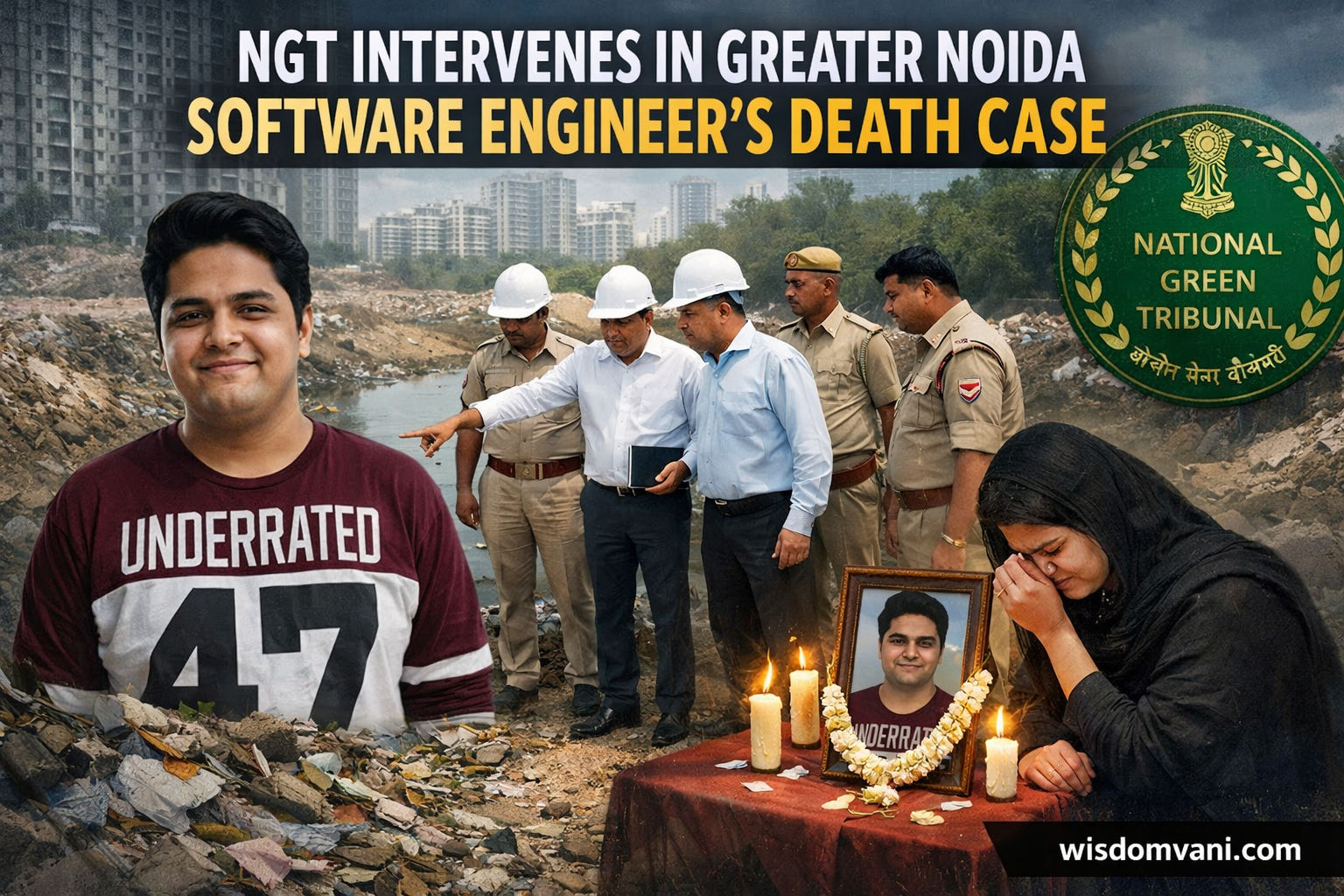
Negligence or Environmental Crime? NGT Intervenes in Greater Noida Software Engineer’s Death Case
Urban development is often viewed through the lens of progress—skylines, shopping malls, and luxury housing. However, a recent tragedy in Greater Noida has exposed the dark side of rapid urbanization: administrative apathy and the complete breakdown of safety protocols.
The National Green Tribunal (NGT) has now taken a firm stand, initiating suo motu (on its own motion) proceedings regarding the death of Yuvraj Mehta. This case isn't just about a road accident; it is a scathing indictment of how "urban ponds" and "forgotten pits" are becoming death traps in our modern cities.
The Incident: A Life Cut Short by Infrastructure Failure
On the morning of January 17, 2026, the air in Sector 150, Greater Noida, was thick with winter fog. Yuvraj Mehta, a 27-year-old software professional, was navigating the low-visibility roads in his SUV. He was a resident of the same sector, yet even local knowledge couldn't save him from a hidden hazard.
As he attempted a turn, his vehicle plunged into a massive, 30-foot-deep excavation. This wasn't a natural lake or a marked construction zone—it was a neglected pit that had filled with water over several years.
The tragedy was compounded by the duration of the struggle. According to medical reports, Mehta didn't die instantly. He fought for nearly 90 minutes in the freezing, polluted water. The cause of death—asphyxiation and cardiac failure—highlights the sheer terror and helplessness of an accident caused by someone else's negligence.
From Commercial Plot to Hazardous Reservoir
How does a prime piece of real estate become a 30-foot deep drowning hazard? The history of the site reveals a timeline of industrial and administrative failure:
The Original Plan: The land was originally sanctioned for a private commercial mall.
The Neglect: After the initial excavation, the project stalled. Instead of being secured or filled back, it was left open to the elements.
Environmental Degradation: Over time, the pit became a collection point for rainwater and, more alarmingly, wastewater discharge from the surrounding high-rise societies.
The Transformation: What was once a building site "illegally transformed" into a stagnant, toxic water body.
The NGT pointed out that this transformation is a direct violation of land-use laws. A site designated for commerce cannot be allowed to rot into a hazardous swamp under the nose of the authorities.
Why the NGT Categorizes This as an "Environmental Crime"
Many might ask: Is this a matter for the Green Tribunal or just the local police? The NGT’s Bench, led by Chairperson Justice Prakash Shrivastava, has clarified that this falls squarely within their jurisdiction for several reasons:
1. Breach of the Environment (Protection) Act, 1986
The authorities failed to implement mandatory environmental safeguards. Stagnant water bodies created by illegal sewage discharge aren't just safety risks; they are ecological hazards that violate the fundamental right to a clean and safe environment.
2. Failure of Waste Management
The fact that nearby housing societies were discharging wastewater into an open pit indicates a total collapse of the local sewage and drainage infrastructure. This is a "scheduled enactment" violation that the NGT is designed to penalize.
3. Decades of Unimplemented Plans
The most shocking revelation in this case is the "Paper Project" of 2015. Over ten years ago, the Uttar Pradesh Irrigation Department proposed a plan to build a head regulator to divert excess water into the Hindon River. Despite the Noida Authority releasing funds for the design in 2016, the project never saw the light of day. This decade-long delay directly contributed to the waterlogging that killed Yuvraj Mehta.
Accountability: Arrests and Administrative Fallout
The public outcry following the incident was immediate and intense. Residents of Sector 150 took to the streets, demanding more than just "condolences."
Legal Consequences for Developers
The police have moved swiftly against the private entities involved. Abhay Kumar, a director at Wiztown Planners, was taken into custody. The charges are severe, including:
Culpable Homicide (not amounting to murder).
Causing death by negligence.
Endangering human life through the omission of safety barriers.
Administrative Shake-up
The Uttar Pradesh government has felt the heat of the NGT’s scrutiny. In a rare move of immediate accountability, the CEO of the Noida Authority was removed from their post. A Special Investigation Team (SIT) is now dissecting the roles of various civic agencies to determine who ignored the repeated warnings sent by local residents months before the accident.
The Path Forward: NGT’s Mandate
The Tribunal has summoned several high-ranking departments, including the UP Pollution Control Board and the District Magistrate. They have been ordered to explain—via sworn affidavits—why such a dangerous site was allowed to exist in a high-traffic residential zone.
The NGT is leveraging the precedent set by the Supreme Court in the Ankita Sinha case, which empowers the Tribunal to intervene in matters of public interest where environmental negligence leads to loss of life.
Lessons for Urban India
This incident is a wake-up call for every urban planning body in India. Safety is not an "add-on" to construction; it is a foundational requirement.
Open Trenches: Must be barricaded with reflective materials visible in fog.
Stalled Projects: Must be drained or filled by the land-owning authority if the developer fails to do so.
Drainage: Stormwater systems must be executed, not just planned on paper.
Conclusion
The death of Yuvraj Mehta was 100% preventable. It was the result of a "systemic lapse" where every safety net failed. As the NGT continues its probe, the focus remains on ensuring that such "man-made disasters" do not claim another life. For the residents of Noida, the hope is that this legal intervention finally brings the structural changes that have been ignored for a decade.
Comments 0